
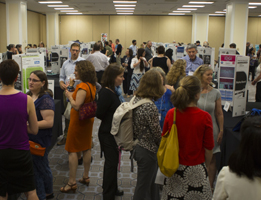
The Conference Board for the Mathematical Sciences (CBMS) is organizing and hosting a National Forum on the Content and Assessment of School Mathematics. The conference is intended to provide an opportunity for policy makers and the broad mathematics education community to provide input into the standards development process. CBMS will produce a white paper on the key issues.
Projects
To find a project on this archived website, we suggest searching the web for “site: cadrek12.org” along with keywords related to the item or topic of interest.
Sort By:
Start Date: Most Recent | Oldest
Alphabetical: A>Z | Z>A
10/01/2009
This project convenes two professional mini-conferences and one professional summit to address issues related to the mathematical education of African American students. Research suggests that there is a negative relationship between African American students and mathematics. This relationship is exacerbated by the underrepresentation of African American students in advanced mathematics classes, even when they are the majority of school populations, and the overrepresentation of African American students in lower-track mathematics courses and special education.
10/01/2009
This project is convening a series of two professional mini-conferences and one professional summit to address issues related to the mathematical education of African American students, Pre-K-16.
10/01/2009
This project is developing and implementing a rigorous eighth grade physical science program that utilizes engineering design, LEGO™ robotics and mechanics, and a problem-based learning approach to teach mechanics, waves, and energy.
09/15/2009
The High Adventure Science project is bringing some of the big unanswered questions in Earth and space science to middle and high school science classrooms. Students will explore the mechanisms of climate change, consider the possibility of life on other planets, and devise solutions to the impending shortage of fresh water. Each curriculum module features interviews with scientists currently working on the same unanswered question.
09/15/2009
This project provides visionary leadership to the education community by (a) identifying and analyzing the needs and opportunities for future STEM curriculum development and (b) recommending policy positions and actions by funding agencies and STEM educators regarding the development and implementation of STEM school curricula.
09/15/2009
Math Pathways & Pitfalls lessons for students boost mathematics achievement for diverse students, including English Learners, English Proficient students, and Latino students. This project develops modules that increase teachers’ capacity to employ the effective and equitable principles of practice embodied by Math Pathways & Pitfalls and apply these practices to any mathematics lesson. This four-year project develops, field tests, and evaluates 10 online professional development modules.
09/15/2009
This project will conduct a 1.5 day regional technical assistance and information conference/workshop for Minority Serving Institutions (MSIs) to broaden their participation in the Division of Research on Learning in Formal and informal Settings (DRL) programs. The workshop will consist of faculty institutional teams and will develop their research or program ideas and to become more skillful in the preparation and development of competitive proposals.
09/15/2009
This project addresses biology teachers and students at the high school level, responding to the exponential increases occurring in biology knowledge today and the need for students to understand the experimental basis behind biology concepts. The project studies the feasibility of engaging students in an environment where they can learn firsthand how science knowledge develops in the fields of bioinformatics and DNA science by performing collaborative, simulated experiments to solve open-ended problems.
09/15/2009
This project is developing and testing a prototype electronic teacher's guide for a 12-week genetics unit in the NSF-funded curriculum titled Foundation Science: Biology to determine how it impacts high school teachers' learning and practice. The electronic guide, which is based on an existing print guide, has a flexible design so that it anticipates and meets the curriculum planning and support needs of teachers with different knowledge/skills profiles.
09/15/2009
This project is developing a two-year, intensive professional development model to build middle-grades mathematics teachers’ knowledge and implementation of formative assessment. Using a combination of institutes, classroom practice, and ongoing support through professional learning communities and web-based resources, this model helps teachers internalize and integrate a comprehensive understanding of formative assessment into daily practice.
09/15/2009
This project is revising and field testing six existing modules and developing, pilot testing, and field testing two engineering modules for required middle school science and mathematics classes: Catch Me if You Can! with a focus on seventh grade life science; and Creating Bioplastics targeting eighth grade physical science. Each module addresses an engineering design challenge of relevance to industries in the region and fosters the development of engineering habits of mind.
09/15/2009
The goals of STEM instruction are to educate a populace that is scientifically and mathematically literate and who can solve real-world problems by applying science and mathematics. This exploratory project is designed to study the effectiveness of professional development focused on the integration of mathematics and science instruction, mediated by technology tools, to improve middle school teachers' ability to teach scientific inquiry and mathematical problem solving.
09/01/2009
This project hypothesizes that learners must have access to the real work of scientists if they are to learn both about the nature of science and to do inquiry themselves. It explores the question "How can informal science education institutions best design resources to support teachers, school administrators, and families in the teaching and learning of students to conduct scientific investigations and better understand the nature of science?"
09/01/2009
The Service, Teaching, and Research (STaR) Project supports networking of early career professionals in mathematics education in higher education. Summer conferences and academic year networking allow time for trust and collegiality to develop, and thereby provide opportunities for important issues/challenges to be identified and addressed. This sustained effort promotes networking, constructs an environment that allows working research groups to be established, and provides time for significant professional growth and leadership capacity to flourish.
09/01/2009
This project investigates how high school students' understanding about design thinking compares to that of experienced practitioners and whether participation in a multiyear sequence of courses focused on engineering correlates with changes in design thinking. The project builds upon the Standards for Technological Literacy and courses developed at the University of Colorado and the University of Maryland, Baltimore County.
09/01/2009
Founded on ethnomathematics research findings, this project aims to increase the mathematics learning of first-, fourth-, and seventh-grade elementary school Micronesian students. Plans are to develop and field-test culturally and linguistically sensitive grade-level curriculum units in specific mathematics topics, such as number and counting, division of whole numbers and fractions, and elements of geometry, focused on the indigenous mathematics learning experiences of eight distinct islands in the Pacific region.
09/01/2009
This project is carrying out a research and development initiative to increase the success rates of our most at-risk high school students—ninth-grade students enrolled in algebra classes but significantly underprepared for high school mathematics. It will also result in new understandings about effective approaches for teaching mathematics to struggling students and about effective ways for implementing these approaches at scale, particularly in urban school districts.
09/01/2009
The Data Games project has developed software and curriculum materials in which data generated by students playing computer games form the raw material for mathematics classroom activities. Students play a short video game, analyze the game data, develop improved strategies, and test their strategies in another round of the game.
09/01/2009
This project is developing and testing assessments for improving instruction, exploring how students can learn challenging content, and enhancing the ability of teachers to provide this content. The guiding question is, Can students develop an understanding of the ecological nature of science (ENOS) in high school biology and environmental science classes that is useful and productive in environmental citizenship?
09/01/2009
This project is studying effects of linguistically sensitive science instructional materials by translating, enhancing, and evaluating culturally relevant and linguistically appropriate Collaborative Online Projects (originally written in Spanish) for middle school Spanish-speaking English Language Learners.
09/01/2009
This research and development project provides resources for ninth-grade mathematics students and teachers by developing, piloting, and field-testing intervention modules designed as supplementary materials for Algebra 1 classes (e.g., double-period algebra). Rather than developing isolated skills and reviewing particular topics, these materials aim to foster the development of mathematical habits of mind—in particular, the algebraic habit of abstracting from calculations, a key unifying idea in the transition from arithmetic to algebra.
09/01/2009
We developed and tested two ecology case study units for urban high school students underserved in their connection to nature. The case studies, based on digital media stories about current science produced by the American Museum of Natural History, use current scientific data to link ecological principles to daily life and environmental issues. Preliminary testing results show that treatment students made significantly higher gains than the control students on the project's major learning goals.
09/01/2009
This project is developing software and curriculum materials in which data generated by students playing computer games form the raw material for mathematics classroom activities. Students play a short video game, analyze the game data, conjecture improved strategies, and test their strategies in another round of the game.
09/01/2009
This project is developing 24 activities that span three years of a Physics high school science curriculum. The activities cover four themes: motion and energy, charge, structure, and light. This study aims to determine the extent to which exposure to these activities in one year influences performance on activities in a subsequent year and the extent to which students can recall concepts from prior years and apply them to new activities in a different discipline.