
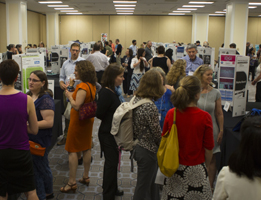
This project will address the question: In what ways can research on learning inform the design of interfaces and technology tools to be used by students accessing large scientific data bases? Oceans of Data will (1) conduct a systematic survey of the widely-dispersed research literature and (2) develop and disseminate a knowledge status report, a resource offering guidance for making these large scientific data bases accessible to and usable by high school science classes.
Projects
To find a project on this archived website, we suggest searching the web for “site: cadrek12.org” along with keywords related to the item or topic of interest.
Sort By:
Start Date: Most Recent | Oldest
Alphabetical: A>Z | Z>A
09/01/2010
This project is a collaborative effort that aims to develop a grade 3-5 Learning Progression that will provide a coherent approach to teaching energy in elementary school and lay a strong foundation for further learning in middle school. The project will identify a network of core concepts and principles about energy that are fundamental and general enough to be compatible with scientific ideas about energy, yet within reach of 5th graders.
09/01/2010
This project uses items and data from the Program for International Student Assessment (PISA) to develop two kinds of resources for preparation and professional development of secondary mathematics teachers: one in the form of prototype professional learning materials and a second in the form of PISA-based, research-grounded articles written for mathematics teachers and teacher educators. Work on both resources will focus on algebra and quantitative literacy and on factors influencing educational equity.
09/01/2010
This project is organizing and hosting a working conference on Response to Intervention (RtI) and related strategies in teaching and assessment in Mathematics. Goals of this work are: To build a community of researchers and practitioners to identify, expand and sustain research needs in this area; to identify and improve the research available related to teaching mathematics within an RtI model; and to develop resources to support teacher's understanding and application of RtI strategies.
09/01/2010
This project investigated the professional development needed to make teachers comfortable teaching with multi-user simulations and communications that students use every day. The enactment with OpenSim (an open source, modular, expandable platform used to create simulated 3D spaces with customizable terrain, weather and physics) also provides an opportunity to demonstrate the level of planning and preparation that go into fashioning modules with all selected cyber-enabled cognitive tools framed by constructivism, such as GoogleEarth and Biologica.
09/01/2010
This project will investigate how complex systems concepts supported by innovative curricular resources, technology applications and a comprehensive research and development structure can assist student learning in the domain of biology by providing a unifying theme across scales of time and space. The project seeks to address four areas of critical need in STEM education: biological sciences, complex systems, computational modeling, and equal access for all.
09/01/2010
This project integrates American Sign Language (ASL) into the life and physical sciences content of 9th-12th grade deaf or hard-of-hearing students. Project partners incorporate the use of the assistive technology in order to develop, research, and disseminate two interactive 3D dictionaries: Signing Life Science Dictionary (SLSD), and Signing Physical Science Dictionary (SPSD) with audio modes and approximately 750 standards-based terms in English and Spanish text that can be signed or listened to on demand.
09/01/2010
In response to the increased use of formative assessment practices in California's PK-12 mathematics classrooms, this project will investigate what formative assessments are in use, how practitioners and students are utilizing these assessments, and how they impact performance on summative state assessments. The main outcome of this study will be a set of research-informed and field-tested conclusions, recommendations, guidelines, and tools for the development and use of new or improved PK-12 mathematics formative assessments.
09/01/2010
This project transforms an already-useful curriculum to reach a wider population of students and teachers. The curriculum effectively builds on a base of core science and math concepts to bring important current science to high school, using a case-based approach that incorporates authentic scientific inquiry. The Biocomplexity and the Habitable Planet curriculum is designed to provide material for a year-long capstone course in ecology and environmental science, or two individual modules for semester-long electives.
09/01/2010
This project will develop and systematically investigate a teaching model to assist teachers in developing ideas about proof in grades 2-5. The teaching model provides both a tool for learning on the part of elementary teachers and a model of practice from which they can learn as they implement it.
09/01/2010
This project evaluates the benefits of using different types of place-based ecological data in high school science classrooms. This project will assess the use of first-hand (collected by students) and real-time second-hand data in teaching science and critical thinking skills. The guiding question for the project is "Does using place-based, first-hand ecological evidence, and relating that to place-based, second-hand data, improve students' environmental science literacy, nature of science understanding, and knowledge of ecological concepts?"
09/01/2010
This project is studying the impact of implementing a NSF-funded, high school mathematics curriculum that emphasizes mathematical habits of mind. This curriculum focuses on ways of thinking and doing mathematics in contrast with curricula that focus on mathematical topics. The project is studying the development of teachers' mathematical knowledge for teaching and their capacity to align their instruction with the new curriculum.
09/01/2010
This project is creating and studying a blended professional development model (face-to-face and online) for mathematics teachers and special educators (grades 4-7) with an emphasis on teaching struggling math students in the areas of fractions, decimals, and positive/negative numbers (Common Core State Standards). The model's innovative design differentiates professional learning to address teachers' wide range of prior knowledge, experiences, and interests.
09/01/2010
This project will develop a mathematics course for the fourth year of high school. The new course is being designed for students who will enter post-secondary education and will major in programs not requiring Calculus. The new course includes mathematics from a problem-solving or applications perspective, and serves as a bridge to college mathematics and statistics. Unit topics include functions, modeling, algebraic strategies, binomial distributions, and information processing.
09/01/2010
This project is using Second Life and other technology to structure carefully planned learning experiences for pre-service teachers. Virtual technologies are used to provide pre-service teachers practice in presenting and assessing problem solving activities in a virtual classroom with diverse populations. Researchers hypothesize that technology enriched strategies have the potential to deepen pre-service teachers' understanding and effectiveness in teaching emerging algebra concepts to diverse student populations.
09/01/2010
This synthesis project is a systematic review of experimental research evaluating programs and practices in elementary science. The systematic review addresses all areas of science in the elementary grades. The review uses an adaptation of best-evidence synthesis previously applied to elementary and secondary mathematics and reading, and includes experimental and quasi-experimental research on the outcomes of alternative approaches to elementary science.
08/15/2010
This project conducts interdisciplinary research to advance understanding of embodied learning as it applies to STEM topics across a range of current technology-based learning environments (e.g., desktop simulations, interactive whiteboards, and 3D interactive environments). The project has two central research questions: How are student knowledge gains impacted by the degree of embodied learning and to what extent do the affordances of different technology-based learning environments constrain or support embodied learning for STEM topics?
08/15/2010
The research and educational activities of this project focus on advancing the field in the area of fraction operation algorithm development. The goal of this research is to identify core mathematical teaching practices that engage and support students in algorithmic thinking associated with fraction operations. The educational product of this work will be written educational materials that can be used to support the general population of teachers in this domain.
08/15/2010
This project explores the potential of "Agent-Based Models" to assist learners to acquire environmental science concepts targeted in forthcoming Advanced Placement test standards. The investigators frame the research in a simulated scenario where "green" infrastructure is integrated into urban environments, and they propose how to use a new user interface strategy ("Paper-to-Parameters") that promises unique approaches for understanding the spatial and scalar relationships between simulation elements.
08/15/2010
This project will bring together two promising innovations: a high school course entitled Energizing Physics and the BEAR assessment system. The goal of this study is to develop and test a formative assessment system for Energizing Physics that has the potential to enable all students to learn physics, so they can succeed in college.
08/15/2010
This exploratory study develops and pilot-tests a model for improving science teaching and learning with middle school ELLs. Study goals include: (1) clarifying pedagogical constructs of language-rich science inquiry and the academic language of science and their relationships across the learning contexts of middle school science classrooms, teacher professional development and family science workshops, (2) developing and refining instruments to study these constructs in context, and (3) conducting pilot tests of the model and instruments.
08/15/2010
Twelve fifth and sixth grade science teacher specialists and their students in a high needs district in Ohio are engaged in a design-based research project within a three-year professional development effort with faculty in several departments at the University of Cincinnati to study how the engineering design process can be used effectively as a pedagogical strategy in science instruction to improve student interest, learning and skill development.
08/15/2010
This research and development project examines the impact of the Project-Based Inquiry Science (PBIS) middle school science curriculum. The research questions explored will look into efficacy, implementation, and teacher practice. A unique feature of the study’s design is an analytic focus on the conditions needed to implement the curriculum in ways that improve student learning in light of the Framework for K-12 Science Education.
08/15/2010
This project develops a series of interactive on-line games and investigates the effect these games have on increasing middle school science students' and teachers' knowledge and skills of scientific argumentation. There are four areas of argumentation addressed by the games: (1) understanding a claim, (2) judging the evidence about a claim based on type and quality (objectivity, reliability or validity), (3) analyzing the reasoning applied to the claim, and (4) evaluating the claim.
08/15/2010
This research and development project develops and tests in the classroom three fifth-grade and two second-grade science units that combine both socio-cultural and socio-cognitive perspectives in order to more fully engage both students and teachers in authentic inquiry and tests the units in second- and fifth-grade classrooms.