
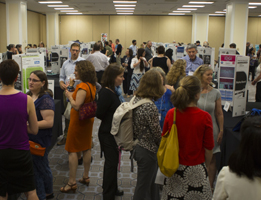
The conference will attract thought leaders, policy makers, supervisors of practice and scholars of measurement science to be informed of emerging thought and developments and to discuss selected models for the implementation of new ways of generating and utilizing data from education tests.
Projects
08/01/2019
The project will develop and research a new Mixed Reality environment (MR), called GEM-STEP, that leverages play and embodiment as resources for integrating computational modeling into the modeling cycle as part of science instruction for elementary students.
08/01/2019
This project will develop and test a two-year professional development model for secondary school science teacher leaders that will help them support their colleagues in implementing the Next Generation Science Standards (NGSS).
08/01/2019
This project will engage teams of students and teachers of grades 7-12 in four competitive Challenges to design innovative strategies for carbon mitigation in areas such as transportation, agriculture or energy use. The project expands the typical boundaries of schools by enabling teams of students in multiple locations to collaborate in model-based reasoning through online discussion forums, using social media, and crowdsourcing ideas to construct possible solutions to environmental challenges. Project research will examine the impacts of the project on student learning and engagement.
08/01/2019
This project's approach uses two types of embodied performances: experiential performances that engage learners in using their bodies to physically experience scientific phenomena (e.g., the increase of heart rate during exercise), and dramatic performances where learners act out science ideas (e.g., the sources and impact of air pollution) with gestures, body movement, dances, role-plays, or theater productions. The project is adding to the limited science education literature on the use, value, and impact of embodied performances in science classrooms, and on the brilliance, ingenuity, and science knowledge that all youth, and particularly historically marginalized young people, have and can further develop in urban school classrooms.
08/01/2019
The purpose of this project is to fully explore the mathematics education literature to synthesize what validity evidence is available for quantitative assessments in mathematics education.
08/01/2019
The project will develop and research a new Mixed Reality environment (MR), called GEM-STEP, that leverages play and embodiment as resources for integrating computational modeling into the modeling cycle as part of science instruction for elementary students.
08/01/2019
This project will examine how partnerships among state science leaders, education researchers and education practitioners cultivate vertical coherence and equity in state science education.
08/01/2019

This project seeks to strengthen statistics and data science instruction in grades 6–12 through the design and implementation of an online professional learning environment for teachers. In partnership with RTI International, the InSTEP project designed and launched instepwithdata.org, an online professional learning platform that supports in-service teachers in developing both deeper content knowledge in statistics and the pedagogical expertise needed to teach statistics and data science effectively in their classrooms.
InSTEP is intentionally designed as a flexible professional learning experience with no fixed sequence of completing activities and modules. Teachers can chart their own learning pathways, engaging with selected resources or the full collection of materials based on their interests and needs. This flexibility allows educators to work at their own pace while deepening their understanding of key aspects of classroom practice, including selecting meaningful data and statistics tasks, facilitating rich classroom discourse, and making thoughtful choices about technology tools.
InSTEP provides two primary types of learning experiences:
Self-Paced Modules. These modules support focused exploration of 7 individual dimensions, helping teachers strengthen both their statistical content knowledge and instructional practice. Together the 7 interconnected dimensions characterize effective learning environments for teaching data science and statistics, as shown in the accompanying diagram. As of January 2026, the platform includes 15 modules spanning the seven dimensions.

Data Investigations. These inquiry-oriented experiences immerse teachers in working with real-world, multivariate datasets using data visualization tools. Each investigation is situated in an authentic context and engages teachers in core Data and Statistical Practices and Central Statistical Ideas. Investigations are organized around the Data Investigation Process (Lee et al., 2022), represented in the puzzle-piece figure. As of January 2026, there are six investigations available.

Validity Evidence for Measurement in Mathematics Education (V-M2ED) (Collaborative Research: Bostic)
08/01/2019
The purpose of this project is to fully explore the mathematics education literature to synthesize what validity evidence is available for quantitative assessments in mathematics education.
08/01/2019
This project will develop and test a professional development program designed for school district science coordinators by examining impacts of participating coordinators on science teachers and their students.
08/01/2019
This project aims to support stronger student outcomes in the teaching and learning of geometry in the middle grades through engaging students in animated contrasting cases of worked examples. The project will design a series of animated geometry curricular materials on a digital platform that ask students to compare different approaches to solving the same geometry problem. The study will measure changes in students' procedural and conceptual knowledge of geometry after engaging with the materials and will explore the ways in which teachers implement the materials in their classrooms.
07/15/2019
The main goal of this project is to validate a set of rubrics that attend to the existence and the quality of instructional practices that support equity and access in mathematics classes. The project team will clarify the relationships between the practices outlined in the rubrics and aspects of teachers' perspectives and knowledge as well as student learning outcomes.
07/01/2019
This project will address the pressing national need to generate shared, practice-based knowledge about how to implement freely available, high-quality instructional resources (mathematics formative assessment lessons) that have been shown to produce significant gains in student learning outcomes. It will expand a professional development model (Analyzing Instruction in Mathematics using the Teaching for Robust Understanding Framework (AIM-TRU)) that supports teacher learning about effective lesson implementation.
07/01/2019
This project will develop and research AquaLab 9, an online video game to engage middle school students in learning science research practices in life sciences content. By engaging in science research practices, students will develop intellectual skills that link directly to many state academic standards and are important for developing STEM literacy and pursuing STEM career pathways.
07/01/2019
This project addresses a gap between vision and implementation of state science standards by designing a coordinated suite of instructional, assessment and teacher professional learning materials that attempt to enact the vision behind the Next Generation Science Standards. The study focuses on using state-of-the-art technology to create an 8-week long, immersive, life science field experience organized around three investigations.
07/01/2019
This project will provide structured and meaningful scaffolds for teachers in examining two research-based teaching strategies hypothesized to positively impact mathematics achievement in the areas of mathematical modeling and problem solving. The project investigates whether the order in which teachers apply these practices within the teaching of mathematics content has an impact on student learning.
07/01/2019
This project aims to enact and study the co-design of classroom activities by mathematics and visual arts teachers to promote middle school students' data literacy.
07/01/2019
This project will develop and research AquaLab 9, an online video game to engage middle school students in learning science research practices in life sciences content. By engaging in science research practices, students will develop intellectual skills that link directly to many state academic standards and are important for developing STEM literacy and pursuing STEM career pathways.
07/01/2019
The purpose of this project is to gather, analyze, and synthesize mathematics and science education research studies published from 1988 to the present that have investigated different approaches to supporting students in grades 6-14 in learning to analyze, interpret, and reason about data.
07/01/2019
This CAREER award aims to study the construct of "epistemic empathy" and examine how it can be cultivated in science and mathematics teacher education, how it functions to promote responsive teaching, and how it shapes learners' engagement in the classroom. In the context of this project, epistemic empathy is defined as the act of understanding and appreciating another's cognitive and emotional experience within an epistemic activity aimed at the construction, communication, and critique of knowledge.
07/01/2019
This project will develop and test a leadership model to improve K-8 mathematics teaching and learning by involving stakeholders across the K-8 spectrum. The project will support teachers, teacher leaders, and administrators in collectively identifying and addressing problems of practice in the teaching and learning of mathematics, and in turn develop plans to improve school and district organizational capacities to support stronger mathematics teaching.
07/01/2019
The aim of this project is to enact and study a process in which middle school teachers of mathematics and visual arts co-design and teach activities that combine math and art to teach data science.
07/01/2019
The project will create opportunities for teachers to develop programming content knowledge and new understandings of the creative possibilities in computer science education, thereby increasing opportunities for students to develop conceptual and creative fluency with programming.
07/01/2019
This project will study the activities of a Networked Improvement Community (NIC) as a vehicle to bridge gaps across four identified steps along the science teacher training and development pathways within local contexts of 8 participating universities. The overarching goal of the project is to strengthen the capacity of universities and school districts to reliably produce teachers of science who are knowledgeable about and can effectively enact the Next Generation Science Standards (NGSS), although prepared in varied organizational contexts.